


Arris S33 vs. SB8200: Which Gigabit Modem is Actually Better?
If you have upgraded to a Gigabit internet plan—or anything over 500 Mbps—you have likely hit a common bottleneck: your old modem. To get the speeds you are paying for, you need a modem capable of DOCSIS 3.1.
Two of the most popular contenders in this space are from the same manufacturer: the Arris Surfboard SB8200 and the newer Arris Surfboard S33. On paper, they look incredibly similar. Both are DOCSIS 3.1, both are approved by major US cable providers (like Xfinity, Cox, and Spectrum), and both promise lightning-fast speeds.
But there are critical differences in their hardware design, port capabilities, and "future-proofing" that make one a distinct winner for power users.

At a Glance: The Core Differences
Before we dive into the technical testing, here is the high-level breakdown of how these two distinct modems compare.
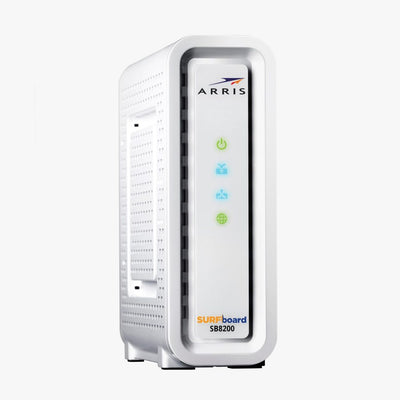
- Arris SB8200: The reliable workhorse. It features two 1-Gigabit Ethernet ports and a classic vented design. It is perfect for standard Gigabit plans (up to 1000 Mbps).
- Arris S33: The speed demon. It features a dedicated 2.5-Gigabit Ethernet port plus a secondary 1-Gigabit port. It is designed for multi-gig plans (1.2 Gbps to 2.5 Gbps).
Shop the Arris S33 at ModemGuides
Round 1: Speed and Ports
The 2.5G Advantage of the S33
The biggest difference between these two units is the Ethernet ports on the back.
The SB8200 has two 1-Gigabit ports. In theory, you can use "Link Aggregation" (LAG) to combine them and get 2 Gbps speeds, but in practice, this is difficult to set up and requires a very specific (and expensive) router. For 99% of users, the SB8200 caps out at 1 Gbps.
The S33 simplifies this massive bottleneck. It includes a dedicated 2.5 Gbps port. This means if your ISP offers a 1.2 Gbps or 2 Gbps plan, you can plug a single cable from the modem to a 2.5G-capable router (like the Eero Pro 6E or ASUS GT-AX6000) and immediately get those speeds without complex configuration.
Winner: Arris S33
Round 2: Design and Heat Management
Modems run 24/7, and DOCSIS 3.1 modems run hot. Heat is the enemy of electronics longevity, often causing dropped connections or premature failure.
The SB8200's Ventilation
The SB8200 uses the classic Arris matte shell with holes everywhere. It is essentially a vented box. This allows for excellent passive airflow. It runs warm, but it dissipates heat very effectively.
The S33's Aesthetic Choices
The S33 is much smaller, rounded, and white. It looks much more modern and "living room friendly." However, in shrinking the size, Arris reduced the surface area for heat dissipation. While it is generally stable, the S33 tends to run hotter to the touch than the SB8200.
Winner: Arris SB8200 (for cooling efficiency)
Shop the Arris SB8200 at ModemGuides
Round 3: ISP Compatibility
Both modems use the Broadcom BCM3390 chipset, which is the gold standard for DOCSIS 3.1. This makes them highly compatible with almost all US cable providers.
- Xfinity (Comcast): Both are supported, but the S33 is often recommended for their "Gigabit Extra" (1200 Mbps) tier because the SB8200 cannot output the full 1200 Mbps through a single port.
- Cox & Spectrum: Both are fully certified.
- Sparklight & Optimum: Both generally work well, though you should always check your specific ISP's "Approved Modems" list before buying.
Winner: Tie (Though S33 wins for plans over 1 Gbps)
Final Verdict: Which Should You Buy?
The choice comes down to your current internet plan and your plans for the future.
Choose the Arris SB8200 if:
- You have an internet plan of 1 Gbps or slower.
- You want a proven, ventilated design that runs cooler.
- You are budget-conscious (it is often slightly cheaper).
Choose the Arris S33 if:
- You have (or plan to get) an internet plan faster than 1 Gbps (e.g., 1.2Gbps or 2Gbps).
- You have a router with a 2.5G WAN port.
- You want the most "future-proof" modem currently available.
Both modems are excellent upgrades over older DOCSIS 3.0 models (like the SB6183 or SB6190). Upgrading to either of these will likely improve your latency and stabilize your connection during peak usage hours.
Ready to Upgrade?
Stop renting your modem and start owning your speed. Check out our certified refurbished inventory to save money on top-tier networking gear.


